
Are Lewis Structures an issue?
Here you can find 5 done exercises about Lewis Structures
You can also read our previous article about Lewis Structures to discover the rules used for doing these exercises.
Write the Lewis structure of N2
To solve this problem we have to follow the 5 rules previously described:
1) Let us sum the valence electrons for all the atoms and then let us divide by two.

2) There is no central atom because the molecule is binary.
3) Let us calculate the pairs of bonding electrons. In this case, the two N atoms follow the octet rule; therefore, they must have 2×8 = 16 electrons around themselves to respect the octet rule. These 16 electrons are equal to 8 pairs of electrons. The number of bonds between the two N is given by the difference between the octet pairs of electrons and the total valence pairs of electrons. Therefore we get:

So, let us write the first draft of the structure:

4) Let us arrange the remaining valence pairs of electrons like lone pairs, in a manner that each atom will observe the octet rule. Since 3 out of the 5 valence pairs have been used for the bonds, only 2 pairs are left to be placed. These two pairs of electrons can be arranged one on each N atom, so that each N will have 8 electrons around.

This is the final structure of the molecule. It is not required to go to the [5] point of the rules, because there are no resonance structures with the same stability in this case. Moreover, it goes without calculating the formal charges, because we do not have any doubts with other possible structures.
Write the Lewis structure of OF2
- Let us sum the valence electrons for all the atoms and then let us divide by two.

- The central atom is oxygen because is the least electronegative atom in the molecule.
- Let us calculate the pairs of bonding electrons. In this case, all the three atoms obey the octet rule, so they must have 3×8 = 24 electrons around themselves to observe the octet rule. These 24 electrons are equal to 12 pairs of electrons. The number of bonds between O and F is given by the difference between the total octet pairs of electrons and the total valence pairs of electrons. Therefore we get:

So let us write the first draft of the structure:

- Let us arrange the remaining valence pairs of electrons like lone pairs, in a manner that each atom will observe the octet rule. Since 2 out of the 10 valence pairs have been used for the bonds, 8 valence pairs are left to be placed. These 8 pairs can be distributed 2 on the oxygen atom, and the remaining 6 pairs on the two fluorine atoms, so that each atom reaches the octet. Hence, the structure becomes:

This is the final structure of the molecule. It is not required to go to the [5] point of the rules, because there are no resonance structures since there are even no double bonds. Moreover, it goes without calculating the formal charges, because we do not have any doubts with other possible structures.
Write the Lewis structure of HCN
- Let us sum the valence electrons for all the atoms and then let us divide by two.

- The central atom is carbon because is less electronegative than nitrogen. However, carbon has slightly greater electronegativity than hydrogen. In this case, you have to consider that hydrogen cannot be in the centre of the molecule, because H follows the rule of duets and indeed cannot form more than one bond.
- Let us calculate the pairs of bonding electrons. In this case, N and C follow the octet rule, while H the duet one. Hence, they must have (2×8) + 2 = 18 electrons around themselves in order to obey the octet rule. The 18 electrons are equal to 9 pairs of electrons. The number of bonds is given by the difference between the total octet pairs of electrons and the total valence pairs of electrons. Therefore we will have:

So let us write a first draft of the structure, by setting 3 bonds between C and N and 1 bond between C and H, because, otherwise, the hydrogen would make more than one bond violating the duet rule:

- Let us arrange the remaining valence pairs of electrons like lone pairs, in a manner that each atom will observe the octet rule. Since 4 out of the 5 valence pairs have been used for the bonds, only 1 valence pair is left to be placed. This lone pair will go on the nitrogen, which now can reach the octet; carbon has already 8 electrons around itself. The structure becomes then:

This is the final structure of the molecule. It is not required to go to the [5] point of the rules, because there are no resonance structures with the same stability in this case. Moreover, it goes without calculating the formal charges, because we do not have any doubts with other possible structures.
Write the Lewis structure of SO42-
- Let us sum the valence electrons for all the atoms and then let us divide by two.

- The central atom is sulphur because is less electronegative than oxygen.
- Let us count the bonding pairs of electrons. In this case, S and O follow both the octet rule; therefore, they must have 5×8 = 40 electrons to obey the octet rule. These 40 electrons are equal to 20 pairs of electrons. The number of bonds is given by the difference between the total octet pairs of electrons and the total valence pairs of electrons. Therefore we will get:

So let us write a first draft of the structure, by setting 4 single bonds between S and O.
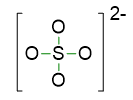
- Let us arrange the remaining pairs of electrons like lone pairs, in a manner that each atom will observe the octet rule. Since 4 out of the 16 valence pairs have been used for the bonds, 12 valence pairs of electrons are left to be placed. These pairs will go 3 on each oxygen atom, since sulphur has already complied with the octet rule. The structure becomes then:
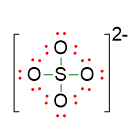
It is not required to go to the [5] point of the rules, because there are no resonance structures since there are even no double bonds. However, since sulphur can extends the octet it is worthy to verify the stability of the obtained structure, by the calculation of formal charges:

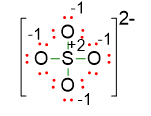
As you can see, sulphur acquires +2 charge, which is too high for a non-metal element. Consequently, we have to consider that the obtained structure is not stable. We need to look for another one, by taking into account that sulphur can expand the octet to 10 or even 12 electrons.
Let us repeat the point 3, while points 1 and 2 are still the same.
- Let us count the bonding pairs of electrons. O is an octet again, whereas sulphur can extend the octet to 10 or 12 electrons. Therefore, in case S has 10 electrons around itself, the total octet electrons will be (4×8)+10 = 42. These 42 electrons are equal to 21 pairs of electrons. The number of bonds is given by the difference between the total octet pairs of electrons and the total valence pairs of electrons. Therefore we will obtain:

So let us write a first draft of this second structure, by setting 3 single bonds between S and O and 1 double bond.
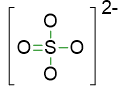
In the alternative case, sulphur expands its octet to 12 electrons; in this case, the total octet pairs of electrons will be 22; consequently, the bonding pairs will be given by:

Therefore, let us write the last draft of the structure, by setting 2 simple bonds between S and O e 2 double bonds.
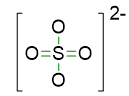
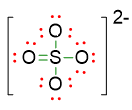
- Let us arrange the remaining valence pairs of electrons like lone pairs, in a manner that each atom will observe the octet rule. Regarding the structure with the sulphur having 10 electrons, 5 out of the 16 valence pairs have been used for the bonds, therefore 11 valence pairs of electrons are left to be placed. These pairs will go 3 on the 3 oxygen atoms which possess a single bond S-O, and the remaining 2 pairs will go on the oxygen involved in the double bond S-O. The structure becomes then:
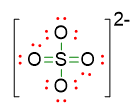
As far as the 12 electrons sulphur is concerned, the lone pairs to settle are instead 10. They will go 3 on the 2 O oxygen atoms which possess the single bond and the remaining 4 pairs on the 2 O involved in the double bonds. The structure will be:
As we have done before, let us calculate the formal charges for these last two Lewis structures. We will end up as follows:
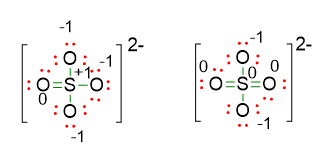
You immediately notice that the first structure has a positive charge upon the sulphur, while in the second structure the sulphur is neutral. Therefore, we can conclude that the second structure, with the 12 electrons expanded octet, is the right one.
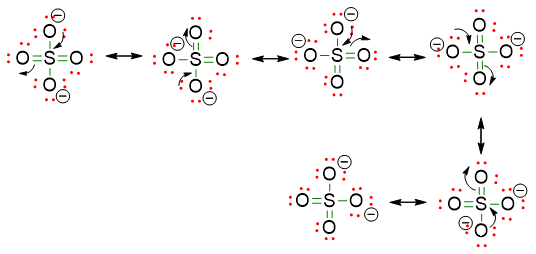
- Since there are double bonds in the molecule, we can write some resonance structures. Therefore the final structure of sulphate ion will be a combination of the following structures:
Write the Lewis structure of NCO–
- Let us sum the valence electrons for all the atoms and then let us divide by two.

- The central atom is carbon because is the least electronegative.
- Let us calculate the pairs of bonding electrons. In this case, all of the three atoms follow the octet rule; therefore, they must have 3×8 = 24 electrons to obey the octet rule. These 24 electrons are equal to 12 pairs of electrons. The number of bonds is given by the difference between the total octet pairs of electrons and the total valence pairs of electrons. Therefore we will have:

So let us write a first draft of the structure, by setting 2 bonds between C and N and 2 between C and O. We could also put 3 bonds between C and N and 1 between C and O, or even 3 bonds between C and O and 1 between C and N. In all we will have three drafts of the structures:

- Let us arrange the remaining valence pairs of electrons like lone pairs, in a manner that each atom will observe the octet rule. Since 4 out of the 8 valence pairs have been used for the bonds, 4 valence pairs of electrons are left to be placed. The carbon atom already comply with the octet rule, therefore the 4 lone pairs have to be settle only on N and O. The three possible structures become then:

- The three Lewis structure we have written above, are also resonance structures. Indeed, all of the three structures differ only for the position of a multiple bond.

- Therefore, the right Lewis structure is a combination of all of the three. However, we can calculate the formal charges to verify which resonance structure is the most stable one. We gain the following charges:

From the obtained results, you can see that the first resonance structure is certainly the least stable one, because a positive charge ends up on an electronegative element such as oxygen. The second and the third structures are the favourable ones, with the last one being slightly more stable because a negative charge goes on the oxygen, which is more electronegative than nitrogen.

Do you need to practise more ? You can find other 5 done exercises in the pdf or docx files below.
Our video – Lewis Structures exercises
This lesson

Lewis Structures-Exercises
€
1.50
Download as pdf (unchageable) file

Lewis Structures-Exercises
€
2.20
Download as docx (editable) file