

Introduction
Are you at the beginning of your Organic Chemistry studies and finding alkenes difficult to understand? Then this article is for you! In fact, with simple words and no unnecessary talk, this seemingly confusing topic will quickly become clear. Moreover, since this site was created to support students, you will have access to the following tools as additional help:
The PDF or DOCX file of this article, so you can review the notes offline;
A free quiz to test your knowledge after reading the article;
A downloadable concept map (soon available) to get a visual summary of the entire topic.
And now it’s time to get started! Arm yourself with a little patience and confidence in your abilities. Happy reading!
What are alkenes?
Alkenes are organic compounds made up of only carbon (C) and hydrogen (H). Their general formula is CnH2n, where n is an integer greater than or equal to 2.
So, the first alkene has n = 2 and the general formula C2H4, commonly called ethylene, although the IUPAC name is ethene. Next comes propylene (or propene) with the formula C3H6, but-1-ene with C4H8, pent-1-ene with C5H10, and so on. The figure below illustrates these first four simplest alkenes.


Take the article on alkenes with you: download it in PDF or DOCX. You can find the article here.
Alkene nomenclature
Alkene nomenclature is not very different from that of alkanes. In fact, the first part of their name, the root, is identical to that of alkanes and indicates the total number of carbon atoms. For 2 carbon atoms the root is eth-, for 3 prop-, for 4 but-, while starting from 5 carbon atoms the root derives from the Greek numerical prefix. The table below lists all the roots from 2 to 20.
Alkene nomenclature, however, differs from that of alkanes for three reasons:

Are you sure you’ve understood how to name alkenes? If you’re still confused, I’ve provided some solved exercises below that put the theory into practice. If, on the other hand, you think you’ve understood everything, try the exercises on your own.
Solved Exercises
Give the name of the following alkene:
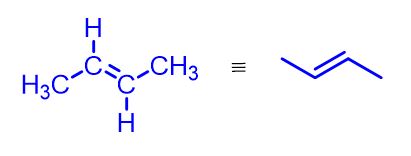
1) Let’s number the chain and assign the root — The chain has 4 carbon atoms, so the root is but-.
2) Let’s identify the position of the double bond — To determine the position of the double bond, we need to number the chain. Let’s try numbering it from both ends in order to consider all possible options.

In this case, whether we number the chain from left to right (numbers in red) or from right to left (numbers in green), the lowest number assigned to the double bond is always 2, because it identifies the first carbon involved in the double bond. Therefore, the required number is 2.
3) Now, let’s add the suffix -ene, which is typical for a double bond.
So, by putting together points 1, 2, and 3, we obtain the name of the alkene:
Note: Some books still use nomenclature like 2-butene, where the double bond number is placed at the beginning of the root rather than between the root and the suffix. This is no longer accepted by IUPAC nomenclature and should therefore be avoided.
Give the name of the following alkene:

1) Let’s number the chain and assign the root — The chain has 8 carbon atoms, so the root is oct-.
2) Let’s identify the position of the double bond — To determine the position of the double bond, we need to number the chain. Let’s try numbering it from both ends to consider all possible options.

Numbering the chain from left to right (numbers in red) places the first carbon atom of the double bond at position 3. Numbering the chain from right to left (numbers in green) places the first carbon of the double bond at position 5. Therefore, the first numbering is correct, as it gives the double bond the lower number. The required number is thus 3.
3) Now, let’s add the suffix -ene, which is characteristic of a double bond.
So, by combining points 1, 2, and 3, we obtain the name of the alkene:
Give the name of the following alkene:

1) Let’s number the parent chain and assign the root – Since, this time, the chain is not linear but has substituents, there are multiple possible chain lengths (two, in this case). To better understand, let us assign consecutive numbers to each carbon atom in one of the two linear chains.
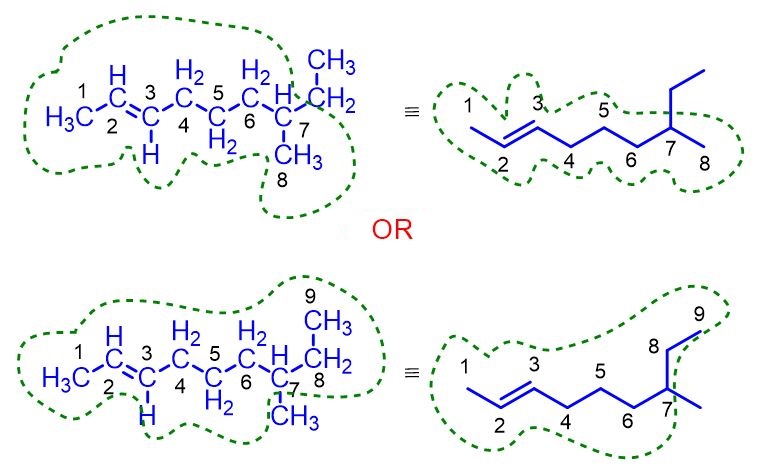
We can immediately see that one linear chain contains 8 carbon atoms, while the other contains 9. Both chains include the double bond, so the fundamental requirement—that the parent chain must necessarily contain the double bond—is satisfied in both cases.
In this situation, to distinguish between the two chains, we must choose the longer one; therefore, the 9-carbon chain is selected, and the root is NON-.
2) Let us determine the position of the double bond. To do so, we need to number the longest chain (the blue one) from both directions.

The chain numbered from left to right (red numbers) places the first carbon atom of the double bond at position 2. In contrast, the chain numbered from right to left (green numbers) places the first carbon atom of the double bond at position 7. Therefore, the first numbering is correct, as it gives the double bond the lower number. The position of the double bond is thus 2.
3) Let’s add the suffix -ene, which is characteristic of a double bond.
So, combining points 1, 2, and 3, we obtain:
4) Let us number and name the substituent. However, the name non-2-ene is not yet complete, because the chain has a substituent that we previously excluded, namely a -CH₃ group.
To include the substituent, we need to assign it a name and a number indicating its position. Since the substituent consists of only one carbon atom, its root name will be METH- (indicating a single carbon), and the suffix -yl shows that it is a simple substituent not part of the parent (longest) chain. Therefore, the name of the substituent is methyl.
The number to assign to it is 7, because it corresponds to the carbon atom to which it is attached according to the numbering established in point 2.
Dunque il nome finale dell’alchene in questione è:
Give the name of the following alkene:
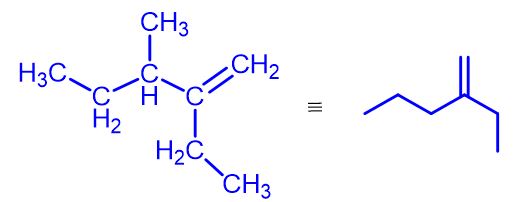
1) Let’s identify the parent chain and assign the root – Since the chain is not linear but has branches, there are several possible chain lengths. To better understand, let us assign consecutive numbers to each carbon atom in every possible linear chain.
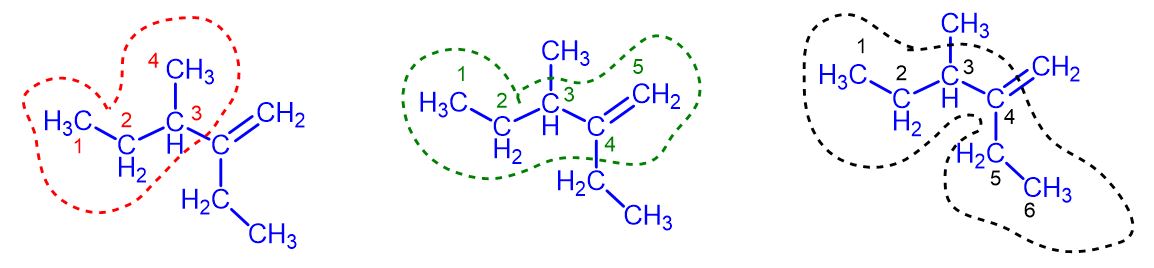
In the first case (red numbers), the linear chain does not contain the double bond, so it cannot be the parent chain. Moreover, it has a much smaller number of carbon atoms (only 4) compared to the other two.
In the second case (green numbers), the linear chain contains the double bond and has 5 carbon atoms.
In the third case (black numbers), the chain is longer, with 6 carbon atoms, but it does not contain the double bond.
Since we have established that the parent chain must contain the double bond as a priority over length, the main chain is therefore the second one, with 5 carbon atoms (green numbers).
2) Let’s determine the position of the double bond – Once the parent chain has been identified, we need to determine the correct direction for numbering it. Let’s number the parent chain (highlighted in blue) from both ends.
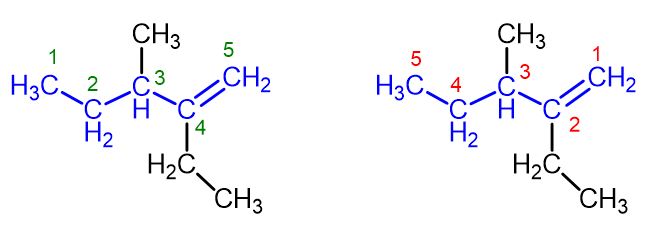
The chain numbered from left to right (green numbers) places the first carbon atom of the double bond at position 4. In contrast, the chain numbered from right to left (red numbers) places the first carbon atom of the double bond at position 1.
Therefore, the second numbering is correct, as it assigns the lower number to the double bond. The position of the double bond is thus 1.
3) Let’s add the suffix -ENE, which is characteristic of a double bond.
So, combining points 1, 2, and 3, we obtain:
4) Let us number and name the substituents. The name pent-1-ene is not yet complete, because the chain has two substituents that we previously excluded: a –CH₃ group and a –CH₂–CH₃ group. To include the substituents, we must assign each a name and a number indicating its position. The –CH₃ substituent, consisting of a single carbon atom, takes the root METH- (indicating one carbon) and the suffix –YL, which shows that its role is that of a simple substituent excluded from the parent chain. Therefore, the name of the first substituent is methyl, and it is assigned the number 3, since it is attached to carbon atom 3 according to the numbering established in point 2. The second substituent consists of two carbon atoms, so its name is formed from the root ETH- (two carbon atoms) and the suffix –YL, giving ethyl. The ethyl substituent is assigned position 2. As for the order in which substituents are cited, they are listed in alphabetical order; therefore, in our case, ethyl is written before methyl.
Therefore, the final name of the alkene in question is:
Note: If you have any doubts about the nomenclature of more complex organic molecules, check out our comprehensive article, “All Organic Chemistry Nomenclature,” which covers organic nomenclature in its entirety and provides a complete and definitive overview of the topic.
Traditional Nomenclature
Some alkenes still retain a nomenclature different from the IUPAC system, known as “traditional nomenclature,” because it originated from the common language used by scientists before the development of a systematic and universal naming system.
However, traditional nomenclature is still widely used, so it is important to learn it in order to communicate effectively with chemists—especially the more senior ones!
In the table below, you will find the most commonly used traditional names for alkenes, alongside their corresponding IUPAC names.
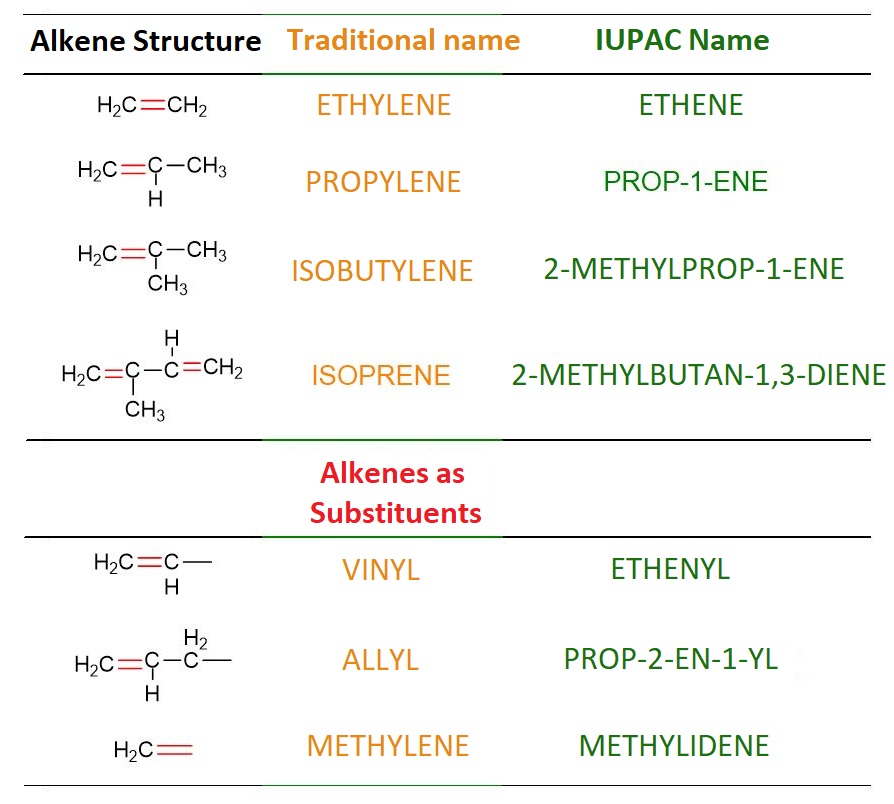
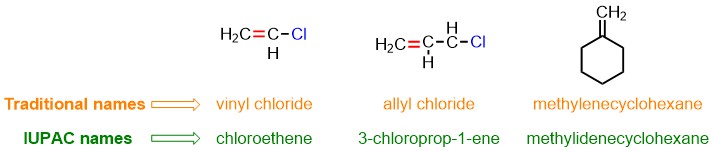
In the last three rows of Table 2, some examples of traditional names for substituent alkenes are reported. These names can be used to designate certain olefins, as shown in the figure below.
Alkene hybridization
In the article on alkanes, we learned that the carbon atoms in these molecules are all sp³ hybridized.
But what is the hybridization of alkenes?
In fact, all the carbon atoms in an alkene that are NOT involved in the double bond will continue to have sp³ hybridization and therefore a tetrahedral geometry.
The hybridization changes only for the carbon atoms involved in the double bond. These, in fact, will have sp² hybridization.
But what does this mean? Let’s recall the electron configuration of carbon. It has two electrons in the 2s orbital and two electrons in the 2p orbitals. However, in order for the carbon atom to form four bonds, one of the electrons in the 2s orbital is promoted to an empty 2p orbital. See the animated figure below.

At this point, there are four unpaired electrons in the s and p orbitals. To form the double bond, these orbitals undergo hybridization—that is, they mix together to create a new set of orbitals capable of forming the double bond. Unlike sp³ hybridization, where all four orbitals mix together, in sp² hybridization only three orbitals hybridize (one s orbital and two p orbitals, px and py), while the remaining orbital (the pz orbital) remains unchanged.
When these three orbitals hybridize, they change shape to adopt a new form that reflects the characteristics of all three original orbitals. Since the s orbital is spherical and the p orbitals are dumbbell-shaped (bilobed), the resulting sp² hybrid orbitals have a shape that is intermediate between spherical and bilobed. See the sp² orbitals in the image below.
These hybridized orbitals adopt a planar arrangement in space, with 120° angles between one orbital and another.
The pz orbital, which did not hybridize with the others, remains unchanged and lies above and below the plane of the sp² hybrid orbitals (last image in Figure 4).

But how does the double bond actually form?
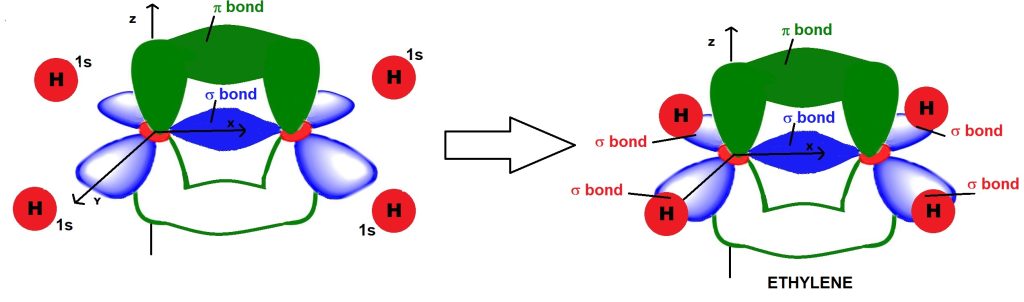
Let’s make two sp² hybridized carbon atoms interact with each other. One sp² orbital of one carbon atom interacts with an sp² orbital of the other carbon atom to form a σ-type bonding orbital (shown in blue in Figure 5).
The σ orbital has cylindrical symmetry with respect to the axis connecting the two carbon nuclei. In other words, this orbital resembles a sort of “sausage-shaped” region extending around the imaginary axis passing through the two interacting nuclei.
However, both carbon atoms also possess an unhybridized pz orbital. The unhybridized pz orbitals interact laterally with each other, creating a π-type bonding molecular orbital, with electron density located above and below the xy plane.

The π orbital is in fact the orbital responsible for the formation of the double bond in alkenes. Compared to a σ orbital, it is weaker because it has a node along the axis passing between the two interacting nuclei and originates from two orbitals that overlap only laterally and only at two regions.
However, the double bond between two carbon atoms is overall stronger than a single C–C bond, because the two nuclei are held together by both a σ bond and a π bond, whereas a single C–C bond consists of only one σ bond.
What happens to the other two sp² hybrid orbitals present on each carbon? These orbitals can be used to form additional σ bonds with other carbon atoms or with hydrogen atoms.
For example, in ethene (C₂H₄), the sp² hybrid orbitals that are not involved in forming the double bond each interact with an s orbital of a hydrogen atom through σ interactions (Figure 6).
Bond lenght
The C=C double bond in alkenes is shorter than the C–C single bond in alkanes. This is because, in the double bond, the combined presence of the π bond and the σ bond adds electron density between the two carbon nuclei, compared to the electron density provided by the σ bond alone in alkanes.
If we take the ethylene molecule as an example again, we see that the C=C bond length is 1.34 Å (Figure 7), whereas the C–C bond length in the corresponding alkane (ethane) is 1.54 Å. However, if we also compare the C–H bond lengths in ethylene and ethane, we notice that these bonds are also shorter in ethylene (1.09 Å vs 1.10 Å).
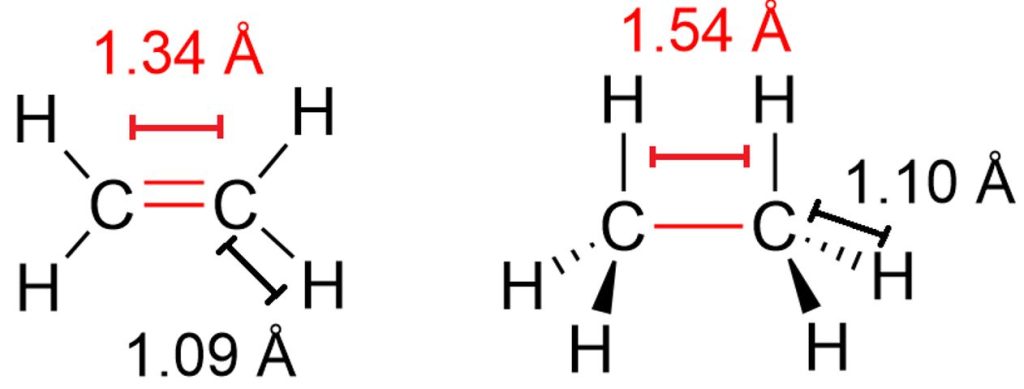
The shortening of the σ bonds of the two carbon atoms involved in the double bond is a consistent feature in alkenes and is due to the sp² hybridization of these atoms. In fact, compared to sp³ hybridization, sp² hybridization involves a greater contribution of the s orbital to the resulting hybrid orbitals, since one s orbital and two p orbitals interact. By contrast, in sp³ hybridization the contribution of the s orbital is lower, because the interaction involves one s orbital and three p orbitals. Since the s orbital has electron density very close to the nucleus, the greater s character of the sp² hybrid orbitals makes them more concentrated around the nuclei than sp³ orbitals. As a result, all σ bonds formed by an sp²-hybridized carbon atom are shorter.
The bond lengths for the first four alkenes are reported in Table 3 below. Generally, the typical length of an (sp²)C=C(sp²) bond is around 1.34–1.35 Å, whereas that of an (sp³)C–C(sp³) bond is about 1.54–1.57 Å. Slightly shorter are the distances for an (sp²)=C–C(sp³) bond, with values ranging between 1.48 and 1.51 Å..[1-5]

cis/trans isomerism
The presence of a double bond in alkenes gives rise to a particular type of isomerism that is not found in simple alkanes. This type of isomerism is known as geometric isomerism and involves distinguishing between two isomers: the cis isomer and the trans isomer.
In particular, the presence of the double bond makes the molecule rigid at that point, meaning it is unable to rotate. While there is free rotation around a single C–C bond at room temperature, rotation around a C=C bond is prevented by the presence of the additional π bond. For a C=C bond to rotate, the π bond would need to be broken, which can occur only at very high temperatures (around 300°C), under acidic conditions, or through photocatalysis. It is precisely this rigidity of the C=C bond that makes cis–trans isomerism possible.
But what are these cis and trans isomers? Let’s look at an example.
Let us consider the first alkene that exhibits this type of isomerism, namely but-2-ene. From the image below, it can be seen that in the cis isomer of but-2-ene the two hydrogen atoms are on the same side, and the same is true for the two CH₃ groups. In the trans isomer, on the other hand, the two hydrogen atoms are on opposite sides, as are the two CH₃ groups.
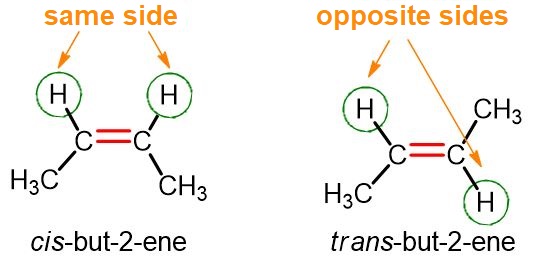
In the case of disubstituted alkenes, such as but-2-ene (that is, with one hydrogen and one substituent on each carbon involved in the double bond), we can say that:
The cis (or Z) isomer is the one in which the two hydrogen atoms (or the two substituents) are on the same side;
The trans (or E) isomer is the one in which the two hydrogen atoms (or the two substituents) are on opposite sides.
Not all alkenes exhibit this type of isomerism. More specifically, alkenes:
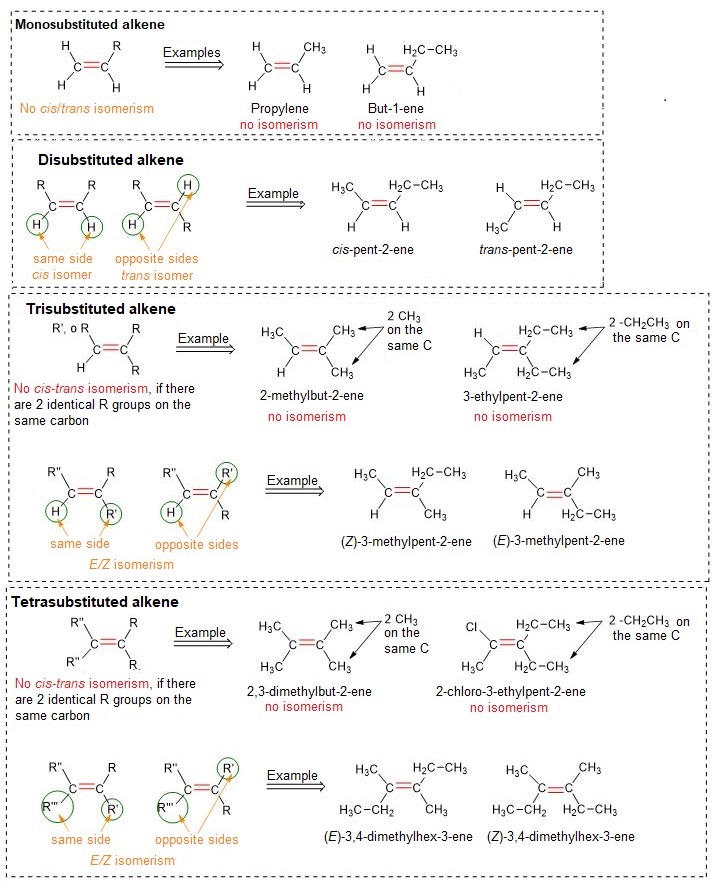
Monosubstituted alkenes never exhibit cis–trans isomerism;
Tri- and tetrasubstituted alkenes exhibit cis–trans isomerism in almost all cases, except when there are two identical substituents on the same carbon atom involved in the double bond.
The image below illustrates these concepts with practical examples. It is worth noting that for tri- and tetrasubstituted alkenes, the cis/trans nomenclature is difficult to apply; therefore, the E/Z system is preferred, which has specific rules for assigning the two isomers. We will not cover these rules in this article, but I will soon provide a dedicated article on this topic.
Stability of alkenes
The image below shows a general stability scale of alkenes. The following information can be observed:
Tetrasubstituted alkenes are more stable than trisubstituted ones;
Trisubstituted alkenes are more stable than disubstituted ones;
Among disubstituted alkenes, the trans isomer is always more stable than the cis isomer;
Disubstituted alkenes are more stable than monosubstituted ones;
Monosubstituted alkenes are more stable than ethylene (that is, a non-alkylated alkene).
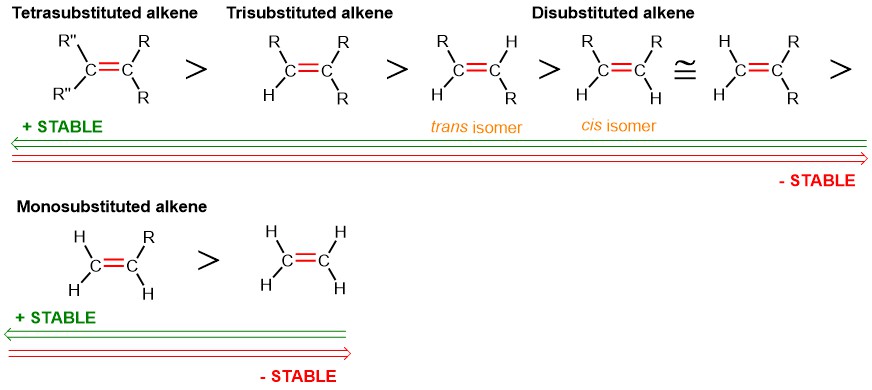
Therefore, in general, we can derive the following rule: the more substituted alkene is more stable than a less substituted one, and the trans alkene is more stable than the cis alkene.
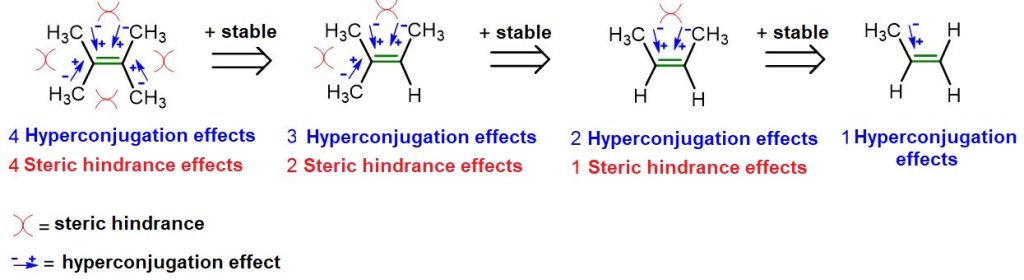
But what is this trend due to? Let’s first look at why a more substituted alkene is more stable than an unsubstituted one.
This is due to a fundamental reason: the more substituted alkene has more alkyl R groups near the double bond, which results in the donation of electron density from the R groups (electron-rich and with sp³-hybridized carbons) to the sp²-hybridized carbons of the double bond, which are more electronegative than the sp³ carbons (see Figure 11).
This phenomenon, known as hyperconjugation, actually involves an overlap of molecular orbitals, which I will explain in more detail in a separate article. In any case, the explanation provided above is more than sufficient to answer a question on the subject thoroughly during an Organic Chemistry I exam.
It is also important to note that, despite the greater steric hindrance of more substituted alkenes, the hyperconjugative effect compensates so effectively for steric repulsions that a tetrasubstituted alkene—thus highly hindered—is significantly more stable than a monosubstituted alkene, where steric repulsions are minimal.
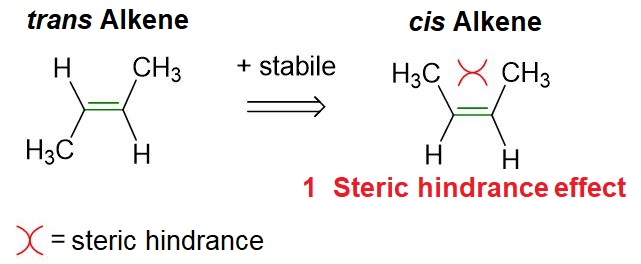
Let us conclude this paragraph by explaining the greater stability of the trans isomer compared to the cis isomer. In this context, the simplest and most widely accepted explanation is that, in the cis isomer, the two R groups are very close to each other and therefore tend to repel one another, thereby destabilizing the entire molecule. In contrast, in the trans isomer, the same R groups are farther apart and thus do not exhibit any repulsion.
Physical properties of alkenes
Alkenes have physical properties similar to those of alkanes: they are also nonpolar molecules and insoluble in water. They are soluble in solvents such as diethyl ether, alcohols, hexane, etc.
The first three alkenes (ethylene, propylene, and butene) are gases; the others, up to C₂₀H₄₀, are colorless liquids with densities lower than that of water. The higher alkenes, on the other hand, are solids.
Boiling points generally increase with chain length, but they also depend on the shape of the molecule and the type of isomerism. Several examples of this can be seen in Table 4. Comparing the boiling points of 1-alkenes, it is evident that, moving from ethylene with 2 carbon atoms to 1-decene with 10 carbon atoms, the boiling point rises dramatically, from -104°C for ethylene to 171°C for 1-decene.
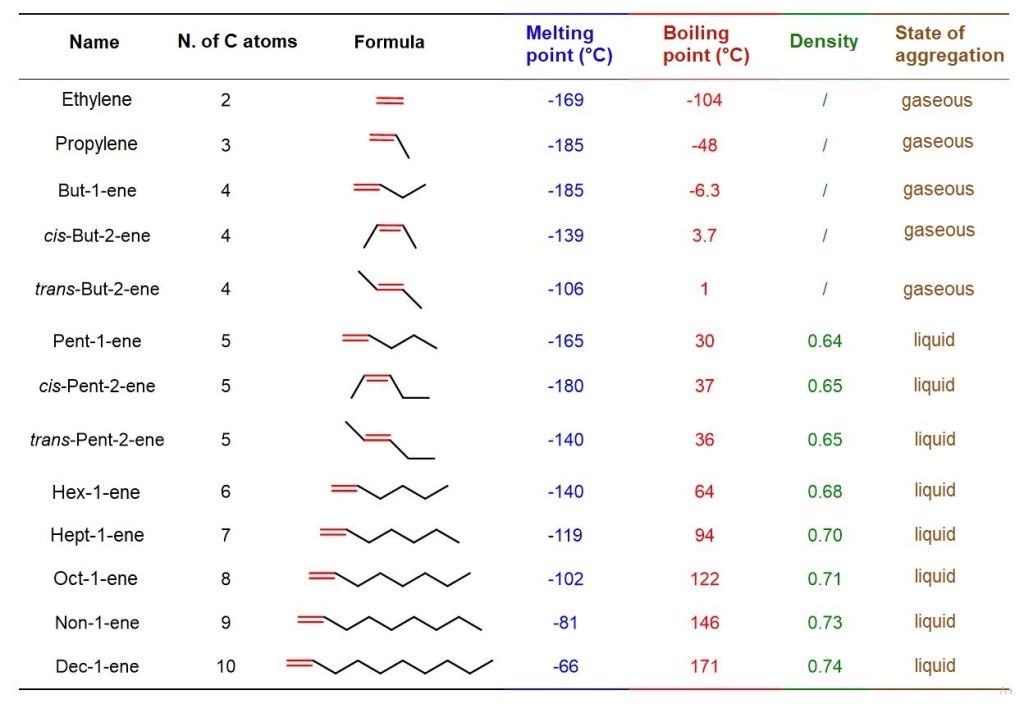
Regarding cis–trans isomerism, cis alkenes generally have higher boiling points than trans alkenes. This phenomenon occurs because trans alkenes are less polar than cis alkenes. In fact, the dipole moments generated by the hyperconjugative electron-donating effect of the R substituents to the sp² carbons of the double bond cancel out in the trans isomer, since the dipole vectors point in the same line but in opposite directions, making the overall polarity of the trans molecule zero. This does not happen in the cis isomer, where the dipole moments add up, resulting in a polar molecule. See an example in Figure 13.

Reactivity of alkenes
Alkenes mainly undergo two classes of reactions: electrophilic addition and polymerization. Both directly involve the double bond.
Let us examine both of them schematically, in order to obtain an overall picture.
Electrophilic addition: an overview
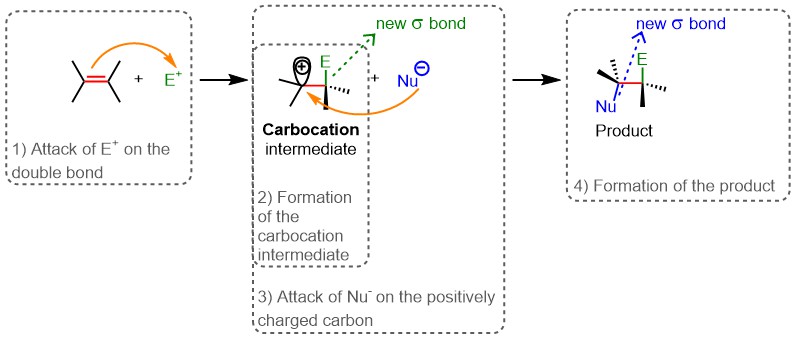
The double bond is an electron-rich center; therefore, electrophilic molecules (electron-deficient species) are attracted to it. Electrophilic addition indeed involves an electrophile (E⁺) that attacks the double bond (Step 1, Figure 14). As a result, the double bond breaks and a reaction intermediate is formed, featuring a new σ bond between E⁺ and one of the carbon atoms involved in the double bond. This intermediate also carries a positive charge on the other carbon atom that did not react with E⁺, because that carbon now forms only three bonds instead of the four typical of its valence. The intermediate in question is therefore called a carbocation (Step 2, Figure 14). Subsequently, the carbocation reacts with a nucleophile (Nu, an electron-rich species), which, attracted by the positive charge, forms a σ bond with the positively charged carbon (Step 3, Figure 14). The reaction product is thus formed: a saturated molecule in which the double bond has been replaced by two new σ bonds (Step 4, Figure 14).
Polymerization
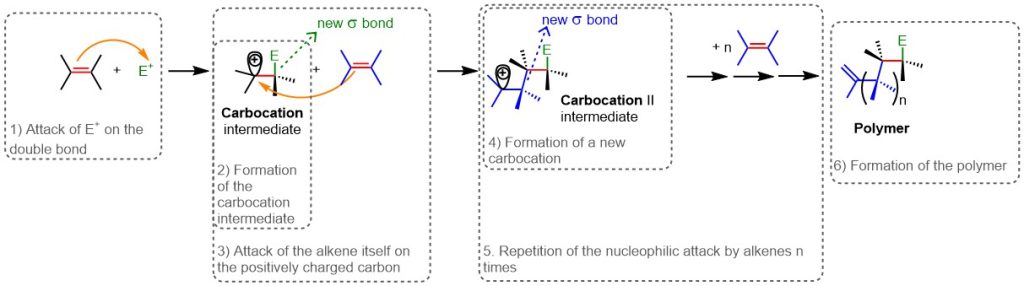
If no nucleophiles are present during the electrophilic addition reaction, the alkene itself—that has not yet reacted—can act as a nucleophile, leading to the polymerization of alkenes. This is possible because the double bond of alkenes is an electron-rich center and can, in fact, function as a nucleophile.
In more detail, after the attack of an electrophile on the double bond (Step 1, Figure 15) and the formation of the carbocation (Step 2, Figure 15), in polymerization another alkene molecule reacts with the carbocation (Step 3, Figure 15). This generates a new carbocation (Step 4, Figure 15), which can in turn react with another alkene molecule, and so on (Step 5, Figure 15). The process repeats many times, producing a polymer (Step 6, Figure 15)—a high-molecular-weight molecule in which molecular units repeat regularly along the length of the polymer chain.
Conclusion
In this article, I have provided you with a brief yet comprehensive overview of alkenes, covering their nomenclature, hybridization, cis–trans isomerism, stability, physical properties, and reactivity.
If all this information is overwhelming you, don’t worry! 💡
You can test what you’ve learned with our free quiz on alkenes, perfect for reviewing the material in an interactive and engaging way.
Do you prefer to study at your own pace? 📚
Download the PDF or DOCX file of this article and read it comfortably offline as well.
And to truly reinforce the concepts in your long-term memory, try our concept map (soon available) on alkenes: a practical and effective way to memorize and summarize the material!⚗️
References
1) Tokue, I.; Fukuyama, T.; Kuchitsu, K. Molecular Structures of Propene and 3,3,3-Trifluoropropene Determined by Gas Electron Diffraction. Journal of Molecular Structure 1973, 17 (2), 207–223. https://doi.org/10.1016/0022-2860(73)85164-6.
2) Van Hemelrijk, D.; Van Den Enden, L.; Geise, H. J.; Sellers, H. L.; Schaefer, L. Structure Determination of 1-Butene by Gas Electron Diffraction, Microwave Spectroscopy, Molecular Mechanics, and Molecular Orbital Constrained Electron Diffraction. J. Am. Chem. Soc. 1980, 102 (7), 2189–2195. https://doi.org/10.1021/ja00527a007
3) Almenningen, A.; Anfinsen, I. M.; Haaland, A. Electron Diffraction Studies of cis– and trans-2-Butene. Acta Chem. Scand. 1970, 24, 43–49.
4) Ter Brake, J. H. M.; Mijlhoff, F. C. Trans-Pent-2-Ene. Electron Diffraction, Vibrational Analysis and Molecular Mechanics. Journal of Molecular Structure 1981, 77 (3–4), 253–263. https://doi.org/10.1016/0022-2860(81)80069-5.
5) Ter Brake, J. H. M. Cis-Pent-2-Ene. Electron Diffraction, Vibrational Analysis and Molecular Mechanics. Journal of Molecular Structure 1984, 118 (1–2), 63–71. https://doi.org/10.1016/0022-2860(84)85180-7.
This lesson

Alkenes-A step by step guide
€
4.00
Download as pdf (unchageable) file

Alkenes-A step by step guide
€
5.00
Downoald as docx (editable) file