
Introduction
One thing has become increasingly clear to me: a surprisingly large number of students are confused about the reaction between Grignard reagents and alkyl halides. After seeing the same questions appear again and again, I decided to investigate the source of the confusion. What I found was unexpected. Although this topic is frequently discussed, truly clear and definitive explanations are remarkably hard to find. As a result, misconceptions keep spreading from one source to another.
This is rather surprising in 2026, when information is readily available and AI tools can provide instant access to scientific knowledge. Yet the confusion remains.
So, let’s examine the chemistry carefully and settle this question once and for all !
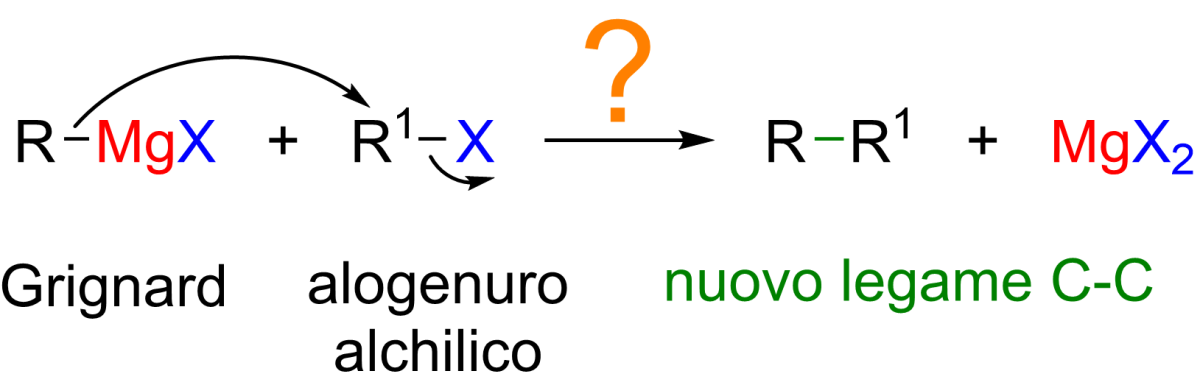
The reaction between Grignard reagents and alkyl halides may seem straightforward, but can it really proceed through a nucleophilic substitution mechanism? Let’s investigate.
The answer
The reaction between a Grignard reagent (nucleophile) and an alkyl halide (electrophile) through a direct substitution reaction would lead to the formation of a new C–C bond.
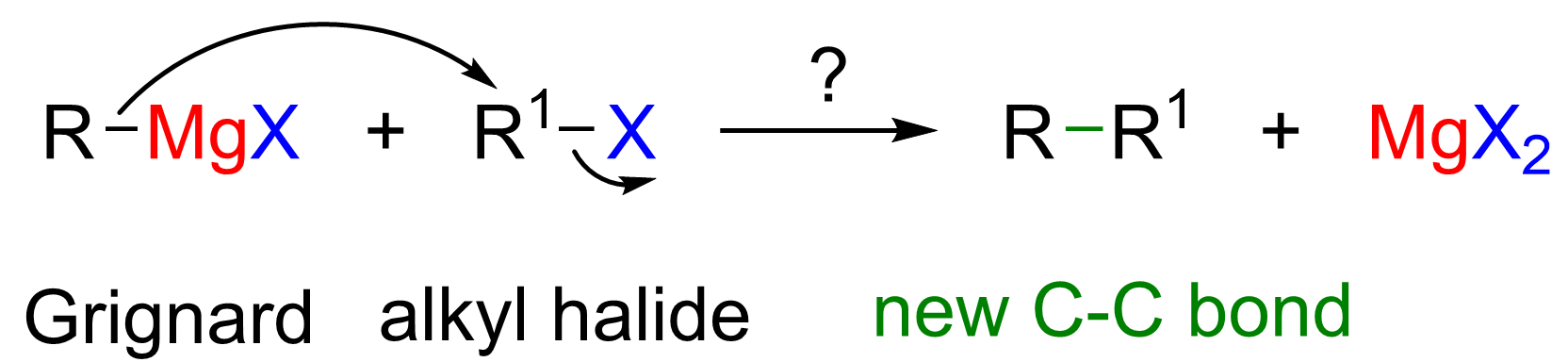
The formation of new C–C bonds is one of the most fascinating achievements in organic chemistry, since it allows us to build complex molecules through carbon chains. For this reason, a reaction that efficiently forms such bonds would have a huge industrial impact—so much so that it might have even earned Grignard a second Nobel Prize! But that didn’t happen. Why not?
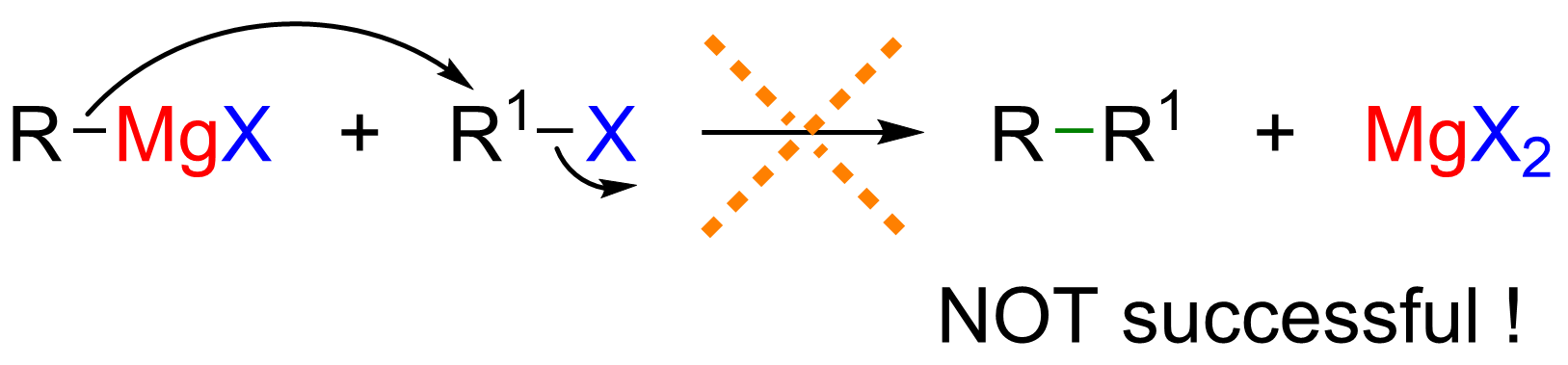
The answer is that this reaction is not successful; it does not proceed in the direction we want. It does proceed somewhere else, but not toward forming new C–C bonds. So where does it go?
It actually goes towards HALOGEN-METAL EXCHANGE!!![1]

The reaction scheme above illustrates a halogen–metal exchange. In this process, a generic alkylmagnesium bromide reacts with an alkyl bromide to give products in which the bromide and the magnesium bromide groups have effectively exchanged positions. As shown, this transformation is an equilibrium rather than a one-way reaction. The position of the equilibrium depends on the relative stability of the carbanions involved and is generally shifted toward the side that generates the more stable carbanion. A simplified stability trend is:
sp > sp² > primary alkyl > secondary alkyl > tertiary alkyl
Therefore, even if a nucleophilic substitution reaction were to occur between a Grignard reagent and an alkyl halide, the outcome would not be as straightforward as one might expect. Because of the competing halogen–metal exchange equilibrium, the reaction would generate a mixture of three different products rather than a single desired compound.

And the story does not end there. Grignard reagents are not just excellent nucleophiles—they are also extremely strong bases. This opens the door to another competing pathway: elimination. Instead of attacking the carbon atom, the Grignard reagent can simply remove a proton, converting the alkyl halide into an alkene.

The consequence? Even more side products. Between halogen–metal exchange and elimination reactions, the desired substitution product quickly becomes only one component of a messy reaction mixture.
The solution
Now we know that the substitution reaction between Grignard reagents and alkyl halides is generally not performed because it results in a messy mixture of products. However, since organic chemists are generally stubborn people, they found a way to carry out the reaction anyway. But how?
By adding a transition-metal catalyst to the reaction mixture, it becomes possible to carry out a coupling reaction between Grignard reagents and alkyl halides. These reactions are known as Kumada couplings, although the term encompasses not only Csp³–Csp³ couplings but also Csp³–Csp², Csp²–Csp², and Csp³–Csp couplings.
Below are some examples of these reactions. Click on each item to view the reaction scheme!
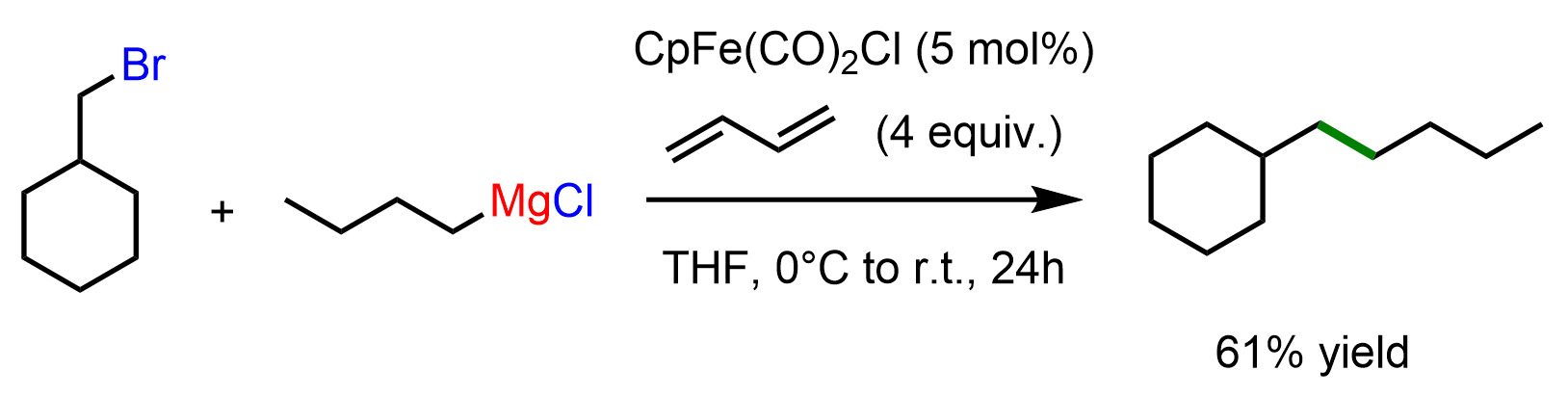
Iron-catalyzed cross-coupling reaction of alkyl halides with alkyl Grignard reagents using cyclopentadienyl ligand and 1,3-butadiene additive. [2]
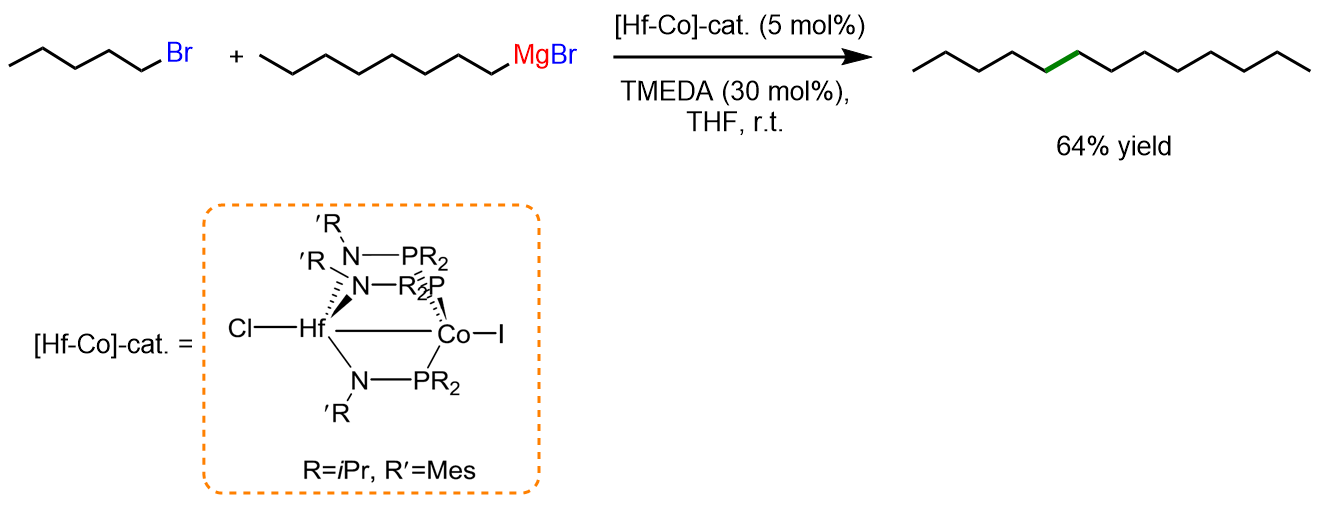
The phosphinoamide-linked Co/Hf complex catalyzed a Kumada coupling between an alkyl halide and an alkyl Grignard reagent at room temperature. [3]

CuI catalyzed a coupling between iodoalkyl esters and Grignard reagents. [4]
Conclusion
Thanks to this article, you’ve finally learned why Grignard reagents are NOT used in nucleophilic substitution reactions with alkyl halides! Now you won’t be confused anymore!
If you’d like to learn more about Grignard reagents, check out our previous articles as well: The mechanism of Grignard reaction: finally unravelled; The publication of the man who hated chemistry.
References
[1] Clayden, J. Organic chemistry, Second edition.; Oxford University Press: New Delhi, India, 2018.
[2] Iwasaki, T.; Shimizu, R.; Imanishi, R.; Kuniyasu, H.; Kambe, N. Cross-Coupling Reaction of Alkyl Halides with Alkyl Grignard Reagents Catalyzed by Cp-Iron Complexes in the Presence of 1,3-Butadiene. Chem. Lett. 2018, 47 (6), 763–766. https://doi.org/10.1246/cl.180201.
[3] Heravi, M. M.; Zadsirjan, V.; Hajiabbasi, P.; Hamidi, H. Advances in Kumada–Tamao–Corriu Cross-Coupling Reaction: An Update. Monatsh Chem 2019, 150 (4), 535–591. https://doi.org/10.1007/s00706-019-2364-6.
[4] Lu, D.; Guan, W.; Yang, X.; Wang, Y.; Kambe, N.; Qiu, R. Cu-Catalyzed Dual C–O Bonds Cleavage of Cyclic Ethers with Carboxylic Acids, NaI, and TMSCF3 to Give Iodoalkyl Ester. Org. Lett. 2022, 24 (15), 2826–2831. https://doi.org/10.1021/acs.orglett.2c00732